ROCOES Optical
HOME > Optical Filters
HOME
>
Optical Filters
>
Polarizer
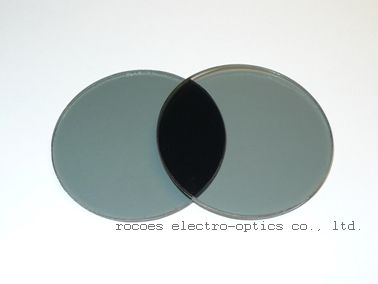
Precision Linear Optical Polarizers & Polarizing Filters
Precision optical polarizers (also known as polarizing filters or linear polarization optics) are engineered optical components that selectively transmit light waves of a specific polarization state while blocking or reflecting orthogonally polarized light components.
Functions:
Constructed by laminating high-dichroic polarizing thin films between optical glass substrates or applying wire-grid micro-patterning/dielectric coatings on glass. Polarizers allow light oscillating along a single axis to pass through while attenuating cross-axis light. By aligning two linear polarizers in sequence and adjusting their relative rotation angle (0° to 90° cross-polarization), system light transmittance can be smoothly controlled from peak transmission down to near extinction (0% to ~38% total unpolarized throughput), eliminating unwanted glare, reducing surface reflections, and enhancing image contrast.
Applications:
Glare-suppression illuminators
Polarimetric measurement instruments
Stress/strain optical inspection equipment
Liquid crystal display (LCD) backlight modules
Professional photography and camera lens setups
Automated Optical Inspection (AOI) vision systems
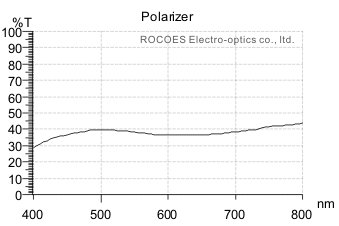
ITEM NO: PL
Spectral Characteristics
Tave=38 +/-2% @ 400-800nm
Physical Characteristics
2.5mm
Round: Dia48, Dia50mm
Suggested use environment:
Temperature: -20~60°C
Humidity: 10~45%RH
Information and Notes
1. Precision optical polarizers are manufactured by laminating high-dichroic polarizing films between high-flatness optical glass substrates or depositing micro-wire-grid structures to achieve high extinction ratios and high damage thresholds.
2. Transmittance for unpolarized light reaches up to 38%–42% for a single linear polarizer. Using two polarizers in a crossed configuration (90° relative rotation) enables variable light attenuation down to near complete extinction (OD3+).
3. Optical glass encapsulation protects the internal polarizing layer against ambient humidity, thermal degradation, and mechanical abrasion, ensuring long-term optical performance.
4. Transmittance and polarization efficiency curves reflect actual physical sample measurement data captured at normal incidence (0° angle of incidence) and are subject to minor production tolerances within engineering limits.
5. Custom dimensions, mounted frames, and anti-reflection (AR) outer surface coatings are available upon request to reduce secondary reflections.
6. Explore related products and technical solutions: