ROCOES Optical
HOME > Optical Filters
HOME
>
Optical Filters
>
R.O.Y. glass/Long Pass Filters
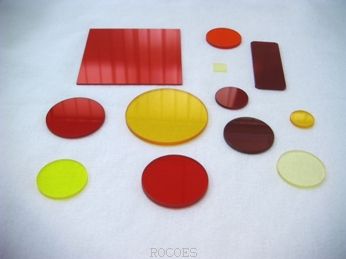
Optical Longpass Glass Filters (Red, Orange, Yellow & IR-Pass Optics)
Optical longpass filters (commonly categorized as sharp-cut absorptive color glass filters or longpass dielectric edge filters) are precision optical elements designed to absorb or block shorter wavelengths (such as ultraviolet, blue, or visible light) while offering high optical transmittance across longer visible, near-infrared, and infrared spectral regions.
Functions: Available in specialized optical glass matrix formulations including Yellow (GG/Y series), Orange (OG/O series), Red (RG/R series), and Infrared Pass (IR/RG series). These filters utilize internal colloidal or ionic bulk material absorption to achieve extremely sharp spectral cutoff transitions, high long-wavelength transmission ($T \ge 85\%–92\%$), and total angular stability (zero angle-of-incidence wavelength shift). They can also be paired with PVD-EBGE thin-film dielectric coatings (e.g., Anti-Reflection AR coatings) to optimize passband throughput and eliminate surface Fresnel loss.
Applications:
Laser safety eyewear
Optoelectronic sensors
Clinical diagnostic instruments
Fluorescence inspection systems
Photographic contrast enhancement
Automated Optical Inspection (AOI) machine vision
Signal-to-noise ratio optimization in Raman and spectroscopic systems.
#O580H #O565H #Y535H
#Y490H #Y450H #Information and Notes
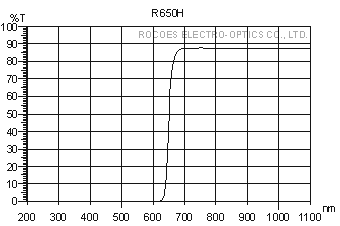
ITEM NO: R650H
Spectral Characteristics
T50%=650 +/-15nm
Tave>80% @ 700-1100nm
Tave<5% @ 200-600nm
*The spectral curve varies with the thickness of glass.
Physical Characteristics
Glass filters: 1~4mm
Square: 8x8 - 150x150mm
Round: Dia8 - 150mm
Resistant Temperature
Glass filters: 100℃
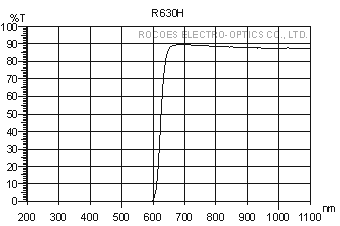
ITEM NO: R630H
Spectral Characteristics
T50%=630 +/-15nm
Tave>80% @ 680-1100nm
Tave<5% @ 200-580nm
*The spectral curve varies with the thickness of glass.
Physical Characteristics
Glass filters: 1~4mm
Square: 8x8 - 150x150mm
Round: Dia8 - 150mm
Resistant Temperature
Glass filters: 100℃
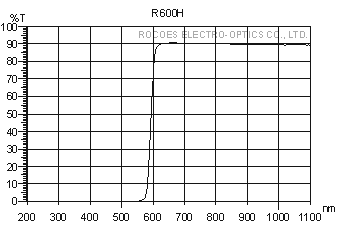
ITEM NO: R600H
Spectral Characteristics
T50%=600 +/-15nm
Tave>80% @ 650-1100nm
Tave<5% @ 200-540nm
*The spectral curve varies with the thickness of glass.
Physical Characteristics
Glass filters: 1~4mm
Square: 8x8 - 150x150mm
Round: Dia8 - 150mm
Resistant Temperature
Glass filters: 100℃
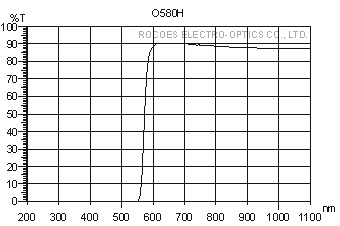
ITEM NO: O580H
Spectral Characteristics
T50%=580 +/-15nm
Tave>80% @ 630-1100nm
Tave<5% @ 200-530nm
*The spectral curve varies with the thickness of glass.
Physical Characteristics
Glass filters: 1~4mm
Square: 8x8 - 150x150mm
Round: Dia8 - 150mm
Resistant Temperature
Glass filters: 100℃
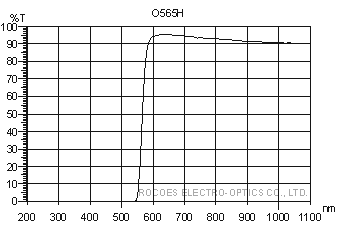
ITEM NO: O565H
Spectral Characteristics
T50%=565 +/-15nm
Tave>80% @ 630-1100nm
Tave<5% @ 200-510nm
*The spectral curve varies with the thickness of glass.
Physical Characteristics
Glass filters: 1~4mm
Square: 8x8 - 150x150mm
Round: Dia8 - 150mm
Resistant Temperature
Glass filters: 100℃
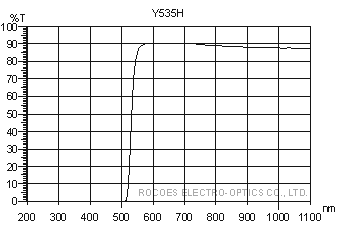
ITEM NO: Y535H
Spectral Characteristics
T50%=535 +/-15nm
Tave>80% @ 590-1100nm
Tave<5% @ 200-480nm
*The spectral curve varies with the thickness of glass.
Physical Characteristics
Glass filters: 1~4mm
Square: 8x8 - 150x150mm
Round: Dia8 - 150mm
Resistant Temperature
Glass filters: 100℃
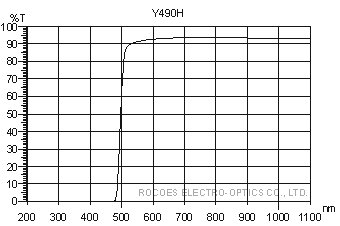
ITEM NO: Y490H
Spectral Characteristics
T50%=490 +/-15nm
Tave>80% @ 540-1100nm
Tave<5% @ 200-440nm
*The spectral curve varies with the thickness of glass.
Physical Characteristics
Glass filters: 1~4mm
Square: 8x8 - 150x150mm
Round: Dia8 - 150mm
Resistant Temperature
Glass filters: 100℃
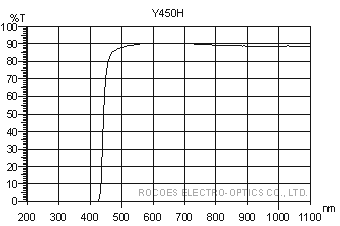
ITEM NO: Y450H
Spectral Characteristics
T50%=450 +/-15nm
Tave>80% @ 500-1100nm
Tave<5% @ 200-400nm
*The spectral curve varies with the thickness of glass.
Physical Characteristics
Glass filters: 1~4mm
Square: 8x8 - 150x150mm
Round: Dia8 - 150mm
Resistant Temperature
Glass filters: 100℃
Information and Notes
1. Red, orange, and yellow glass filters utilize bulk matrix absorption to absorb shorter wavelengths (ultraviolet and blue light) while delivering high optical transmission across red, orange, yellow, and near-infrared spectral regions.
2. Spectral transmittance curves represent physical sample measurements captured at normal incidence (0° angle of incidence, AOI).
3. Absorptive optical glass components are generically referred to as "colored glass filters," "optical colored glass," or "color filters."
4. Spectral transmittance and cutoff steepness vary with substrate thickness according to the Beer-Lambert law; thicker glass increases optical density in absorption bands and sharpens edge transitions.
5. Explore related products and technical solutions: