ROCOES Optical
HOME > For Lighting
HOME
>
For Lighting
>
Heat reflection filters
Heat Reflection Filters (Hot Mirrors & IR-Cut Optics)
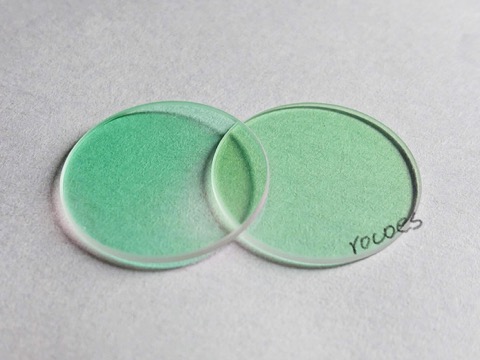
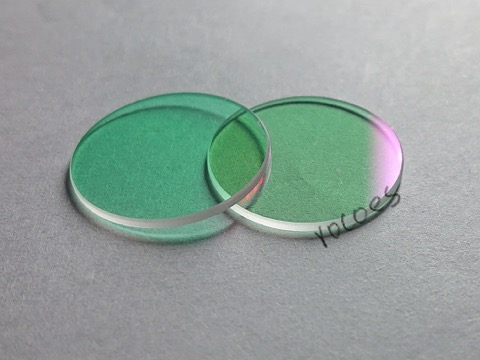
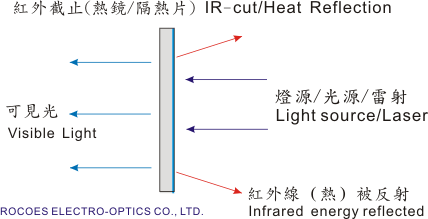
Heat reflection filters (commonly referred to as Hot Mirrors, Heat Reflective Optics, or IR-Cut Filters) are high-precision interference optical filters designed to reflect invisible infrared heat radiation (IR) and ultraviolet radiation (UV) while maintaining exceptionally high luminous transmittance across the visible light spectrum (400 nm – 700 nm).
Functions:
Reflected thermal radiation prevents heat buildup within optical assemblies and illuminated targets, protecting sensitive electronic sensors, optical film components, display modules, and biological tissue from photo-thermal degradation. Manufactured using advanced vacuum thin-film deposition (PVD-EBGE), these filters withstand sustained high-temperature operations up to 450°C–500°C without thermal degradation, film peeling, or optical delamination.
Applications:
Architectural floodlights
Optical fiber illuminators
Machine vision inspection systems
Dental and surgical medical lights
High-intensity projector light engines
Professional stage lighting luminaires
(moving heads, scanners, washers, effect lights)
#UVIRCUT+AR-400/730 #Information and Notes
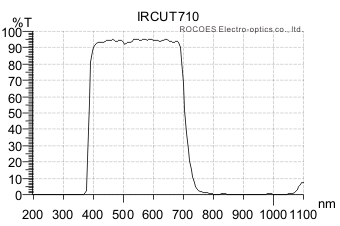
ITEM NO: IRCUT710
Spectral Characteristics
T50%=710 +/-15nm
Tave>88% @ 430-660nm
Tave<3% @ 780-1050nm
Physical Characteristics
Borosilicate: 1.1, 2.0, 3.0mm
Glass: 1.1mm
Tmpered glass: 2.0, 3.0mm
Square: 3*3 - 310*320mm
Round: Dia3 - 300mm
Resistant Temperature
Glass: 150℃
Tempered glass: 250℃
Borosilicate: 450℃
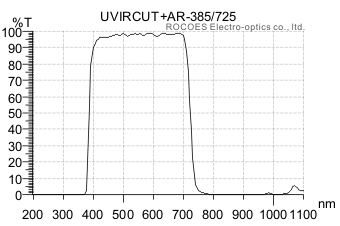
ITEM NO: UVIRCUT+AR-385/725
Spectral Characteristics
Tave<1% @ 200-370nm
Tave>95% @ 430-680nm
Tave<3% @ 800-1000nm
Physical Characteristics
Borosilicate: 1.1, 2.0, 3.0mm
Glass: 1.1mm
Square: 3*3 - 310*320mm
Round: Dia3 - 300mm
Resistant Temperature
Glass: 150℃
Borosilicate: 450℃
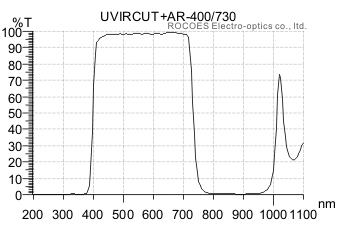
ITEM NO: UVIRCUT+AR-400/730
Spectral Characteristics
Tave<2% @ 200-385nm
Tave>95% @ 430-680nm
Tave<3% @ 800-950nm
Physical Characteristics
Borosilicate: 1.1, 2.0, 3.0mm
Glass: 1.1mm
Square: 3*3 - 310*320mm
Round: Dia3 - 300mm
Resistant Temperature
Glass: 150℃
Borosilicate: 450℃
Information and Notes
1. Heat reflection filters (hot mirrors) are manufactured using optical thin-film vacuum deposition, featuring precision multilayer dielectric stacks typically comprising 36 to 48 layers to achieve sharp spectral reflection of infrared and ultraviolet radiation.
2. Advanced Physical Vapor Deposition with Electron Beam Gun Evaporation (PVD-EBGE) technology ensures high film density, outstanding adhesion, zero film peeling, and superior thermal durability under continuous operation.
3. Transmittance curves represent measurements at normal incidence (0° angle of incidence). Non-transmitted infrared heat radiation is reflected away by the dielectric coating rather than absorbed by the glass substrate.
4. Spectral curves display measured sample values and may exhibit minor tolerances between manufacturing production lots while strictly complying with defined optical specifications.
5. Dimension abbreviations: "Dia." or "Ø" denotes circular outer diameter.
6. Website specifications are provided for reference only. Final production and delivery comply with mutually agreed engineering specifications and actual physical products.
7. Maximum safe temperature ratings define the thermal limit the optical glass substrate can withstand under non-uniform thermal distribution or severe thermal shock conditions.
8. SCHOTT B270®, D263® T, and BOROFLOAT® 33 are registered trademarks of SCHOTT AG.
9. Explore related products and technical solutions: