ROCOES Optical
HOME > For Lighting
HOME
>
For Lighting
>
Diffuser/Frost
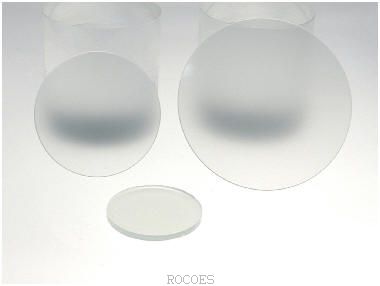
Glass Diffusers & Frost Filters (Light Diffusion Optics)
Glass diffusers and frost filters (also known as frosted glass lenses, optical beam spreaders, or light diffusion plates) are engineered optical elements designed to transform harsh, concentrated light rays into soft, uniformly distributed illumination.
Functions:
Softens direct illumination, broadens beam divergence angles, eliminates hot spots, and effectively reduces glare across the visual field. Available in sandblasted, acid-etched, micro-patterned, or chemically textured surfaces. High-thermal-resistance glass substrates can be integrated with multilayer dielectric thin-film coatings (such as anti-reflective, dichroic color, or UV-cut coatings) to achieve simultaneous light softening and spectral shaping without thermal degradation under high-power illumination.
Applications:
Architectural floodlighting
Commercial display spotlights
LED luminaire diffusion panels
Film and television production lighting
Precision optical sensor homogenizers
Intelligent stage luminaires
(moving head spots/washers, wall washers, effect lights)
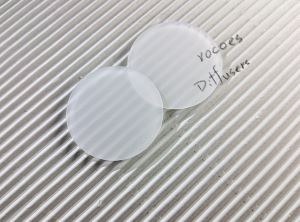
ITEM NO: DIFF10
Transmittance: 90%
Haze: 8% +/-2%
Gloss: 75% +/-10%
Physical Characteristics
Glass: 1.1mm
Tempered glass: 2, 3, 4, 5mm
Borosilicate: 1.1mm
Square: 8x8 - 220x220mm
Round: Dia8 - 210mm
*Tempered glass has a minimum size limit.
Resistant Temperature
Glass: 150℃
Tempered glass: 250℃
Borosilicate: 450℃
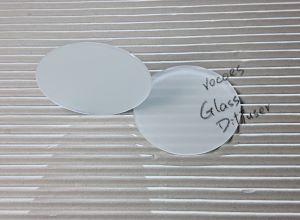
ITEM NO: DIFF20
Transmittance: 80% +/-5%
Haze: 8% +/-2%
Physical Characteristics
Glass: 1.1mm
Tempered glass: 2, 3, 4, 5mm
Borosilicate: 1.1mm
Square: 8x8 - 220x220mm
Round: Dia8 - 210mm
*Tempered glass has a minimum size limit.
Resistant Temperature
Glass: 150℃
Tempered glass: 250℃
Borosilicate: 450℃
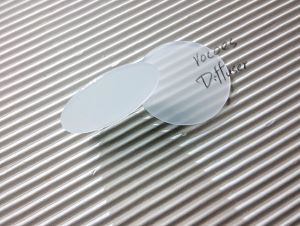
ITEM NO: DIFF30
Transmittance: 76% +/-5%
Haze: 94.5% +/-3%
Physical Characteristics
Glass: 1.1mm
Tempered glass: 2, 3, 4, 5mm
Borosilicate: 1.1mm
Square: 8x8 - 220x220mm
Round: Dia8 - 210mm
*Tempered glass has a minimum size limit.
Resistant Temperature
Glass: 150℃
Tempered glass: 250℃
Borosilicate: 450℃
Information and Notes
1. Light diffusers and frost filters are manufactured using precision surface texturing, chemical etching, or micro-patterned processing to achieve precise beam spread angles and optimal light homogenizing efficiency.
2. High-thermal-stability glass substrates (such as SCHOTT BOROFLOAT® 33 or heat-treated glass) can be integrated with multilayer dielectric thin-film coatings, combining light diffusion with UV-blocking or dichroic color conversion capabilities.
3. Diffusion performance, light transmission efficiency, and beam divergence angles are measured at normal incidence (0° angle of incidence) under standard laboratory light sources.
4. Physical chemical tempering or thermal strengthening applies to substrate processing with minimum dimension and geometric shape limitations. Please refer to Introduction to Tempered Glass for technical details.
5. Dimension abbreviations: "Dia." or "Ø" denotes circular outer diameter.
6. Website specifications are provided for reference only. Final production and delivery comply with mutually agreed engineering specifications and actual physical products.
7. SCHOTT BOROFLOAT® 33 is a registered trademark of SCHOTT AG.
8. Explore related products and technical solutions:
