ROCOES Optical
HOME > Glass
HOME
>
Glass
>
Soda-Lime(Taiwan)
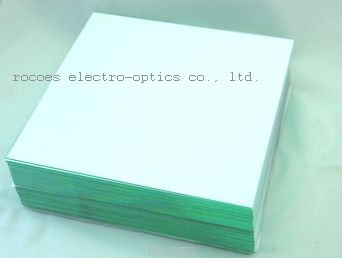
Soda-Lime Glass (Taiwan Glass)
Taiwan Glass soda-lime float glass (also known as sodium-calcium glass) is a versatile commercial-grade optical material offering high cost efficiency and dependable mechanical stability across a wide range of standard thicknesses.
Functions:
Available in versatile thicknesses ranging from 2mm to 20mm. Provides a highly cost-effective alternative to imported glass substrates while maintaining excellent visible light throughput, flat surface uniformity, and reliable structural integrity.
Applications:
Display covers
Lighting enclosures
Industrial machinery viewports
Protective windows for household appliances
Cost-sensitive optical substrate applications.
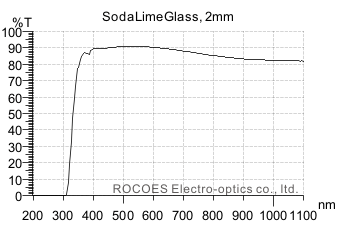
ITEM NO:Glass2
Spectral Characteristics
Tave>88% @ 400-700nm
Physical Characteristics
Thickness: 2.0 +0/-0.2mmm
Square: 20x20 - 800x800mm
Round: Dia50 - 600mm
Resistant Temperature
150℃
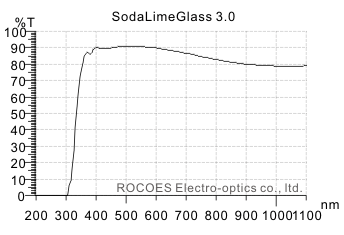
ITEM NO:Glass3
Spectral Characteristics
Tave>88% @ 400-700nm
Physical Characteristics
Thickness: 3.0 +0/-0.2mmm
Square: 20x20 - 800x800mm
Round: Dia50 - 600mm
Resistant Temperature
150℃
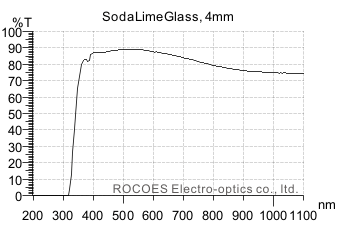
ITEM NO:Glass4
Spectral Characteristics
Tave>86% @ 400-700nm
Physical Characteristics
Thickness: 4.0 +0/-0.2mmm
Square: 20x20 - 800x800mm
Round: Dia50 - 600mm
Resistant Temperature
150℃
Information and Notes
1. Taiwan Glass produces commercial float glass designed primarily for architectural and general display windows. Consequently, its surface quality, inclusions, and internal bubble density are subject to standard commercial tolerances, which are higher than those of specialized optical-grade glass.
2. Custom geometrical profiles, non-standard thicknesses, CNC edge grinding, and precision drilling are available to meet OEM integration requirements.
3. Spectral transmittance curves represent measurements at normal incidence (0° angle of incidence). Non-transmitted light within the spectrum is absorbed by the physical optical properties of the glass substrate.
4. For applications requiring maximized light throughput, please refer to our Anti-Reflective (AR) Coating Solutions.
5. To enhance mechanical strength and thermal shock resistance, please explore our Tempered Glass Solutions.
6. Maximum safe operating temperature indicates the maximum thermal gradient the substrate can withstand without structural failure caused by localized uneven heating. Operating temperatures may be higher under uniform thermal distribution or slow temperature transition rates.
7. Website specifications are provided for reference only. Final production and delivery comply with mutually agreed engineering specifications.