ROCOES Optical
HOME > Laser/Infrared/AOI
HOME
>
Laser/Infrared/AOI
>
RGB bandpass filters
RGB Bandpass Filters (Color Separation Filters)
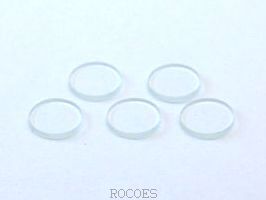
RGB bandpass filters, also known as dichroic filters or trichroic beam splitters, are high-precision optical filters designed for accurate spectral channel separation and color isolation.
Functions:
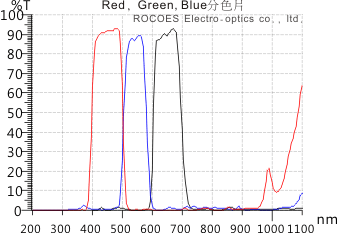
RGB color separation filters effectively isolate broadband white light, daylight, or imaging signals into discrete red, green, and blue primary spectral bands with high transmission within passbands and sharp out-of-band rejection.
Applications:
Automated Optical Inspection (AOI)
Machine vision
Optical imaging equipment
Color sensors
Projector systems.
▽Information and Notes
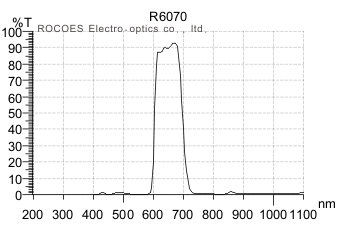
ITEM NO: R6070 (Red)
Spectral Characteristics
Tave<5% 420-550nm
Tave>75% @ 630-660nm
Tave<5% @ 750-1100nm
Physical Characteristics
Glass: 1.1mm
Borosilicate: 1.1mm
Square: 8x8 - 220x220mm
Round: Dia8 - 210mm
Resistant Temperature
Glass:150℃
Borosilicate:450℃
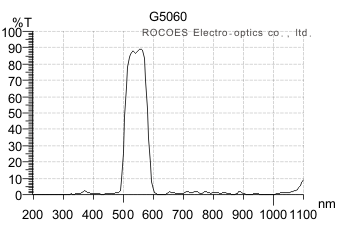
ITEM NO: G500/560 (Green)
Spectral Characteristics
T50%=505/545 +/- 5nm
Tave>88% @ 525-545nm
Tave<5% @ 620-680nm
Tave<3% @ 400-450nm
Physical Characteristics
Glass: 1.1mm
Borosilicate: 1.1mm
Square: 8x8 - 220x220mm
Round: Dia8 - 210mm
Resistant Temperature
Glass:150℃
Borosilicate:450℃
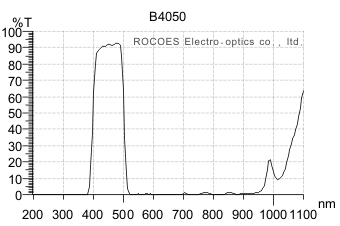
ITEM NO: BP4050 (Blue)
Spectral Characteristics
Tave>85%= 430-470nm
Tave<1% @ 500-900nm
Tave<1% @ 200-370nm
Physical Characteristics
Glass: 1.1mm
Borosilicate: 1.1mm
Square: 8x8 - 220x220mm
Round: Dia8 - 210mm
Resistant Temperature
Glass:150℃
Borosilicate:450℃
Information and Notes
1. RGB bandpass filters are manufactured using vacuum thin-film deposition with 24 to 48 dielectric layers, customizable to meet specific spectral band requirements.
2. Precision coating process utilizing Physical Vapor Deposition with Electron Beam Gun Evaporation (PVD-EBGE).
3. Spectral performance curves are measured at normal incidence (0° angle of incidence). Blocking efficiency in the rejection band is achieved through dielectric film reflection.
4. Spectral curves represent actual sample measurement data. Minor lot-to-lot variations may occur within standard manufacturing tolerances while fully adhering to specified optical definitions.
5. Website specifications are provided for reference only. Final production and delivery comply with mutually agreed engineering specifications.
6. Explore related products and technical solutions: